
Abstract in a Science Fair Project: A Complete Student Guide
An abstract in a science fair project is one of the most important sections of your display board and written report. While it may be short, it plays a powerful role: it summarizes your entire experiment in a clear, professional, and easy-to-understand way. Judges often read the abstract first, teachers use it to evaluate understanding, and students rely on it to explain their work quickly.
Many students struggle with writing a strong abstract because they don’t know what information to include—or what to leave out. This guide will walk you through everything you need to know about writing a clear, effective, and award-worthy abstract for a science fair project.
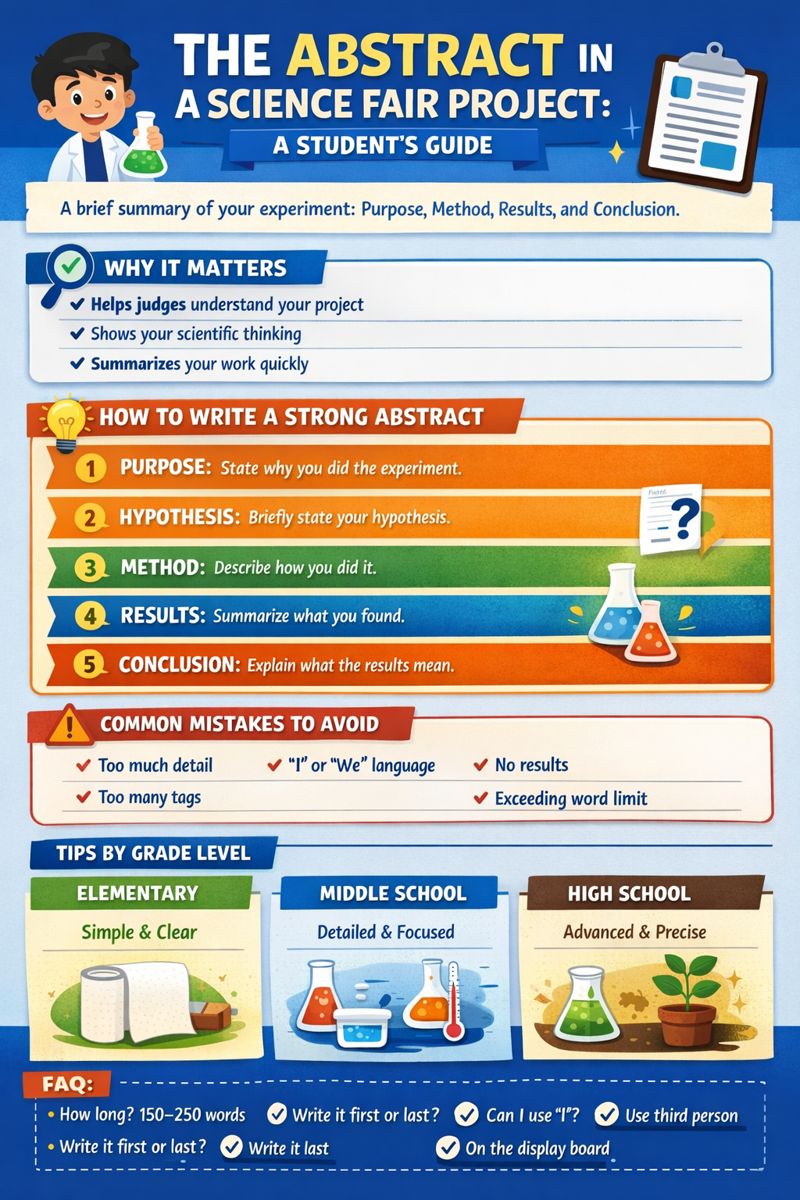
What Is an Abstract in a Science Fair Project?
An abstract in a science fair project is a brief summary that explains the key parts of your experiment. It gives the reader a quick overview of what you studied, why you studied it, how you conducted the experiment, and what you discovered. Think of it as the “elevator pitch” of your science project.
Unlike the introduction or conclusion, an abstract is written in a compact format, usually between 150 and 250 words, depending on grade level and fair requirements. Even though it is short, it must clearly represent the entire project.
A strong abstract includes:
-
The purpose of the experiment
-
The question or hypothesis
-
The methods used
-
The results
-
The conclusion
Judges often decide how well a student understands their project just by reading the abstract. That’s why clarity, accuracy, and organization are essential.
Why the Abstract Is Important for Science Fair Judging
The abstract in a science fair project is often the first thing judges read before visiting your display. It helps them understand your experiment quickly and prepares them to ask deeper questions. A well-written abstract shows that the student understands the scientific process and can communicate ideas clearly.
For large science fairs, judges may review dozens of projects in a short time. A clear abstract allows them to:
-
Identify the project’s goal immediately
-
Understand the experiment without reading the entire report
-
Evaluate scientific thinking and organization
-
Compare projects fairly and efficiently
Teachers also use abstracts for grading because they demonstrate whether the student truly understands the experiment—not just the results, but the reasoning behind them.
A weak abstract, on the other hand, can confuse readers, hide strong results, or make a great project seem incomplete. That’s why learning how to write a proper abstract is just as important as doing the experiment itself.
How to Write a Strong Abstract Step by Step
Writing an abstract in a science fair project becomes much easier when you follow a clear structure. Instead of guessing what to include, break the abstract into five key parts and write one or two sentences for each.
1. Start With the Purpose
Begin by clearly stating the purpose of your experiment. Explain what you wanted to find out or solve. This helps the reader immediately understand the focus of your project.
Example:
The purpose of this science fair project was to determine how light color affects plant growth.
2. State the Hypothesis or Research Question
Next, briefly mention your hypothesis or the main question you investigated. This shows your scientific thinking before the experiment began.
Example:
It was hypothesized that plants exposed to blue light would grow taller than plants exposed to other colors.
3. Describe the Method
Explain how you conducted the experiment in simple terms. Do not include every detail—just the main steps and materials.
Example:
Five identical plants were grown under different colored LED lights for four weeks, and their height was measured weekly.
4. Summarize the Results
This is one of the most important parts of the abstract. Clearly state what happened during the experiment. Use data summaries, not opinions.
Example:
The results showed that plants grown under blue light had the greatest average height, while plants under red light showed the least growth.
5. End With the Conclusion
Finish by explaining what the results mean and whether the hypothesis was supported.
Example:
These findings support the hypothesis and suggest that light color plays an important role in plant growth.
When combined, these parts create a complete, professional abstract that clearly represents the entire project.
Common Mistakes to Avoid in a Science Fair Abstract
Even strong projects can lose points if the abstract in a science fair project is poorly written. Avoiding common mistakes can make a big difference in how your project is evaluated.
One common mistake is writing the abstract before finishing the experiment. Since the abstract summarizes results and conclusions, it should always be written last, after all data is collected and analyzed.
Another frequent error is including too much detail. An abstract is not a lab report. Long explanations, step-by-step procedures, or background research do not belong here.
Students also sometimes forget to include results. An abstract without results is incomplete. Judges want to know what you discovered, not just what you planned to do.
Other mistakes include:
-
Using first-person language like “I” or “we”
-
Adding graphs or charts
-
Writing opinions instead of facts
-
Exceeding the word limit
-
Copying text directly from the conclusion
A strong abstract is clear, concise, and factual. Reading your abstract out loud can help you spot confusing sentences or unnecessary information.
Abstract Examples for Different Grade Levels
The structure of an abstract in a science fair project stays mostly the same across grade levels, but the language and depth vary depending on the student’s age.
Elementary School Example
The purpose of this project was to find out which paper towel brand absorbs the most water. Three brands were tested by dipping them into water and measuring how much water they absorbed. The results showed that Brand B absorbed the most water. This experiment showed that not all paper towels work the same.
Middle School Example
This science fair project investigated how temperature affects the dissolving rate of sugar in water. Sugar was added to water at three different temperatures, and the time taken to dissolve was recorded. The results showed that sugar dissolved fastest in hot water. The hypothesis was supported.
High School Example
The purpose of this experiment was to analyze the effect of soil pH on tomato plant growth. Plants were grown in soils with varying pH levels for six weeks. Growth rate and leaf size were measured weekly. Results indicated optimal growth at a pH of 6.5, supporting the hypothesis.
These examples show how abstracts grow more detailed as students advance, while still following the same basic structure.
FAQ
What is an abstract in a science fair project?
An abstract in a science fair project is a short summary that explains the purpose, method, results, and conclusion of the experiment. It gives readers a quick understanding of the entire project.
How long should a science fair abstract be?
Most science fair abstracts are between 150 and 250 words, but students should always follow the specific rules provided by their teacher or science fair organizer.
Should I write the abstract first or last?
You should write the abstract last, after completing your experiment, analyzing results, and writing your conclusion.
Can I use “I” in a science fair abstract?
Most science fairs prefer abstracts written in third person to keep a formal and scientific tone.
Do all science fair projects require an abstract?
Most regional and national science fairs require an abstract, especially for middle and high school students. Always check your science fair guidelines.
Where does the abstract go on the display board?
The abstract is usually placed near the top of the display board or submitted separately as part of the written report.
Final Thoughts
Writing a clear and effective abstract in a science fair project is a skill that benefits students far beyond the science fair. It teaches how to summarize information, communicate scientific ideas, and think critically about results. When written correctly, an abstract highlights the strengths of a project and helps it stand out to judges and teachers alike.
By following a clear structure, avoiding common mistakes, and focusing on clarity, any student can create a strong abstract that accurately represents their hard work and scientific thinking.