
Conceptual in Science: Why Deep Understanding Matters More Than Memorization
In modern education, especially in STEM fields, the phrase conceptual in science has become more than a buzzword—it represents a fundamental shift in how science should be taught and learned. Instead of focusing on rote memorization of formulas, definitions, and facts, conceptual learning emphasizes understanding the “why” and “how” behind scientific ideas. This approach equips students with the ability to think critically, solve problems creatively, and apply scientific principles to real-world situations.
As science becomes increasingly interdisciplinary and application-driven, developing a conceptual foundation in science is essential for long-term academic success and scientific literacy. In this article, we explore what conceptual learning in science truly means, why it is critical, how it differs from traditional learning methods, and how educators can effectively implement it in classrooms. 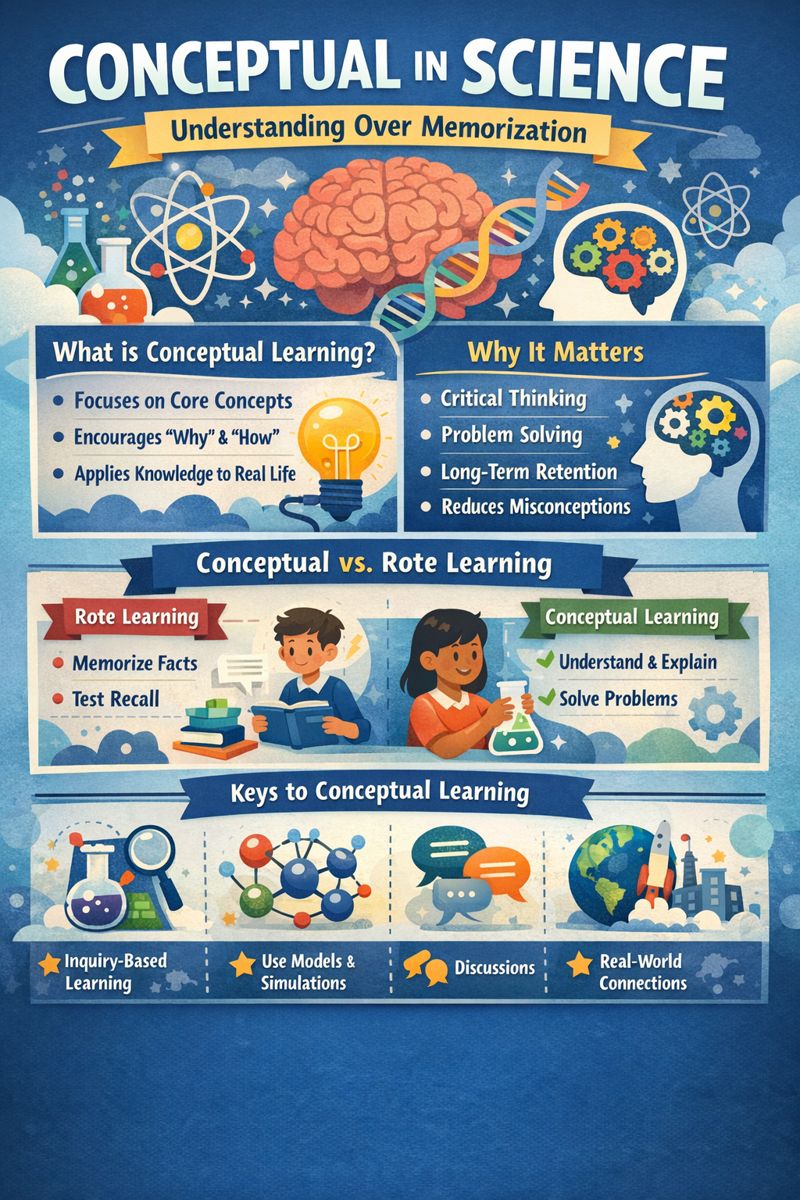
What Does “Conceptual in Science” Really Mean?
The term conceptual in science refers to an approach to learning where students focus on understanding core scientific concepts rather than memorizing isolated facts or procedures. A concept is a big idea that explains patterns or relationships in nature—such as energy, force, ecosystems, matter, or evolution.
In conceptual science learning, students are encouraged to:
-
Understand underlying principles
-
Make connections between ideas
-
Explain phenomena in their own words
-
Apply knowledge across different contexts
For example, instead of memorizing that “force equals mass times acceleration,” students learn what force is, how it affects motion, and why changing mass or acceleration changes the outcome. This deeper understanding allows them to transfer knowledge to new problems rather than forgetting it after an exam.
Key Characteristics of Conceptual Learning in Science
A conceptual approach in science typically includes:
-
Inquiry-based learning
-
Hands-on experiments
-
Use of models and simulations
-
Real-world problem solving
-
Student explanations and reasoning
Unlike traditional instruction, which often emphasizes correct answers, conceptual science prioritizes student thinking. Mistakes are seen as learning opportunities that help uncover misconceptions.
This approach is especially important in foundational science education, where early misunderstandings can persist and hinder future learning.
Why Conceptual Understanding in Science Is So Important
Developing a conceptual understanding in science is crucial for several academic and real-life reasons. Research consistently shows that students who learn conceptually outperform those who rely on memorization, especially when faced with unfamiliar problems.
1. Builds Long-Term Retention
Facts memorized without understanding are easily forgotten. Conceptual knowledge, on the other hand, is stored in a connected mental framework, making it easier to recall and apply later. When students truly understand a scientific idea, they can reconstruct details even if they forget exact wording.
2. Enhances Critical Thinking and Problem Solving
Science is not just about knowing answers—it’s about asking questions, analyzing evidence, and drawing conclusions. A conceptual science approach trains students to think like scientists by:
-
Formulating hypotheses
-
Interpreting data
-
Evaluating explanations
These skills are transferable beyond science, benefiting mathematics, engineering, technology, and everyday decision-making.
3. Reduces Misconceptions
Many students carry misconceptions in science for years, such as believing heavier objects fall faster or that seasons are caused by Earth’s distance from the Sun. Conceptual learning actively addresses these misunderstandings by confronting students with evidence and reasoning.
By emphasizing conceptual clarity in science, educators help students replace incorrect ideas with scientifically accurate ones.
4. Prepares Students for Advanced STEM Learning
As students progress to higher levels of science, topics become more abstract and interconnected. Without a strong conceptual base, advanced subjects like chemistry, physics, and biology become overwhelming. Conceptual learning ensures students are prepared for complex reasoning and interdisciplinary thinking.
Conceptual in Science vs Traditional Rote Learning
To understand the value of being conceptual in science, it helps to compare it with traditional rote learning methods that still dominate many classrooms.
Traditional Rote Learning
-
Focuses on memorization
-
Emphasizes exams and recall
-
Encourages passive learning
-
Often disconnects theory from application
Students may score well on tests but struggle to explain concepts or apply knowledge in new situations.
Conceptual Learning in Science
-
Focuses on understanding
-
Encourages active participation
-
Connects ideas across topics
-
Emphasizes reasoning and explanation
For example, in a traditional classroom, students might memorize the stages of the water cycle. In a conceptual science classroom, students explore why evaporation happens, how temperature affects condensation, and what role the water cycle plays in ecosystems and climate.
The Role of Assessment
Conceptual learning also requires a shift in assessment methods. Instead of only multiple-choice tests, teachers may use:
-
Open-ended questions
-
Projects and investigations
-
Concept maps
-
Oral explanations
These assessment tools better measure whether students truly understand scientific concepts.
How Educators Can Promote Conceptual Learning in Science
Implementing a conceptual approach in science education requires intentional teaching strategies and supportive learning environments. Below are proven methods educators can use to foster conceptual understanding.
1. Inquiry-Based Learning
Inquiry-based learning places students at the center of the scientific process. Instead of giving answers, teachers pose questions and guide students to discover concepts through investigation.
Examples include:
-
Designing experiments
-
Observing natural phenomena
-
Collecting and analyzing data
This approach mirrors how real scientists work and strengthens conceptual understanding.
2. Use of Models and Visual Representations
Scientific concepts are often abstract. Models, diagrams, simulations, and animations help students visualize processes they cannot directly observe, such as molecular motion or energy transfer.
Visual tools are especially effective for reinforcing conceptual clarity in science, particularly for younger learners.
3. Encouraging Explanation and Discussion
Asking students to explain their reasoning—verbally or in writing—reveals how well they understand a concept. Classroom discussions allow students to compare ideas, challenge assumptions, and refine their thinking.
Teachers can ask prompts like:
-
“Why do you think that happened?”
-
“What evidence supports your explanation?”
-
“How does this idea connect to what we learned before?”
4. Connecting Science to Real Life
When students see how science applies to everyday life, concepts become meaningful and memorable. Real-world connections reinforce the relevance of science and strengthen conceptual learning.
Examples include:
-
Applying physics to sports
-
Exploring biology through health and nutrition
-
Understanding climate science through local weather patterns
The Future of Conceptual in Science Education
As education systems worldwide evolve, the emphasis on conceptual in science continues to grow. Modern curricula, digital learning tools, and STEM initiatives increasingly prioritize understanding over memorization.
With the rise of AI, automation, and data-driven careers, students must be able to think critically and adapt knowledge to new situations. Conceptual science learning prepares students not just to pass exams, but to thrive in a rapidly changing world.
Educators, parents, and policymakers all play a role in supporting this shift by valuing depth of understanding, encouraging curiosity, and fostering a lifelong love for scientific exploration.
FAQ
What does “conceptual in science” mean?
“Conceptual in science” refers to learning science by understanding core ideas and principles rather than memorizing facts or formulas. It emphasizes reasoning, connections, and real-world application.
Why is conceptual understanding important in science?
Conceptual understanding helps students retain knowledge longer, apply concepts to new problems, avoid misconceptions, and develop critical thinking skills essential for STEM fields.
How is conceptual science learning different from rote learning?
Rote learning focuses on memorization and recall, while conceptual science learning focuses on understanding, explanation, and application of scientific ideas across contexts.
Can conceptual learning be used at all grade levels?
Yes. Conceptual learning is effective from early elementary science through higher education. The depth and complexity of concepts simply increase with grade level.
How can teachers assess conceptual understanding in science?
Teachers can use open-ended questions, projects, experiments, discussions, and concept maps to evaluate whether students truly understand scientific concepts.
Does conceptual learning improve exam performance?
Yes. Students with strong conceptual understanding tend to perform better on exams that require reasoning, problem solving, and application—not just recall.