
GCSE Science Keywords and Definitions: A Complete Revision Guide for Students
Learning GCSE science keywords and definitions is one of the most powerful revision strategies for students preparing for Biology, Chemistry, and Physics exams. Scientific understanding is not only about knowing ideas but also about expressing them using the correct subject-specific vocabulary. Examiners award marks for accurate terminology, clear definitions, and precise explanations, making keyword mastery essential for success at GCSE level. This in-depth guide is designed to help students, parents, and teachers understand why keywords matter, how they appear in exams, and which definitions students must know to achieve higher grades. The article is structured into four detailed sections, each covering a core aspect of GCSE science terminology, followed by a practical FAQ section.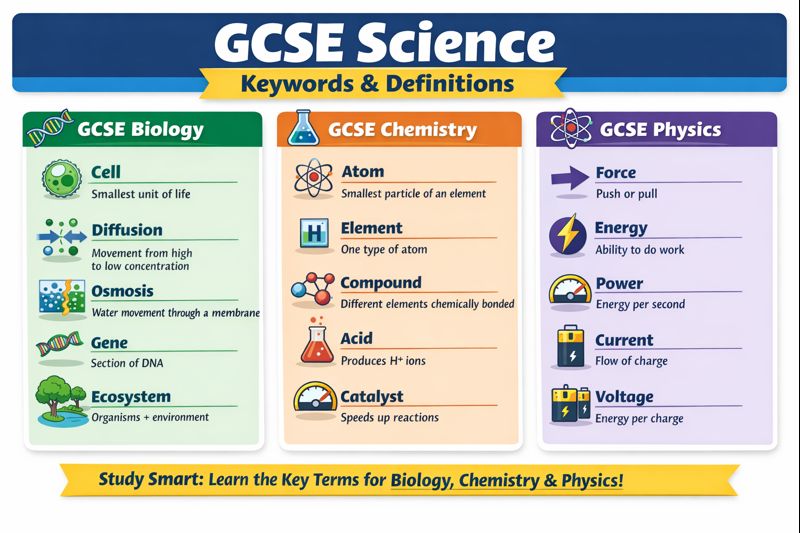
Why GCSE Science Keywords and Definitions Are Critical for Exam Success
GCSE science exams are heavily language-driven. Even calculation questions, practical investigations, and data analysis tasks require students to understand and correctly interpret scientific keywords. Many students lose marks not because they lack understanding, but because they fail to use the correct terminology in their answers.
When exam questions use command words such as describe, explain, compare, or evaluate, they expect students to respond using accurate GCSE science keywords and definitions. For example, writing that energy is “used up” instead of saying it is “transferred” or “dissipated” is a common mistake that leads to mark loss. Similarly, confusing terms like mass and weight or diffusion and osmosis can significantly affect final grades.
Scientific keywords also act as signals for examiners. Mark schemes are built around specific terms, and students who include those terms are more likely to access full marks. This is why teachers often stress learning definitions word-for-word, especially for topics such as cell biology, chemical reactions, forces, and energy.
Another reason GCSE science keywords and definitions are so important is their role in exam literacy. Students who know the terminology can quickly understand what a question is asking, reducing stress and saving time. This confidence often leads to clearer, more structured answers, which examiners reward.
In short, mastering GCSE science keywords improves:
-
Accuracy in written responses
-
Confidence when answering unfamiliar questions
-
Speed and comprehension during exams
-
Overall exam performance across all sciences
Essential GCSE Biology Keywords and Definitions Explained in Detail
Biology contains a large number of keywords related to living systems, processes, and interactions. Many GCSE biology questions rely heavily on definitions, particularly when explaining processes like respiration, photosynthesis, inheritance, and ecology.
At the foundation of biology is the cell, defined as the smallest unit of life. Students must understand the roles of organelles such as the nucleus, which controls cell activities and contains genetic material, and the mitochondria, which is the site of aerobic respiration where energy is released. The ribosomes are responsible for protein synthesis, a definition that frequently appears in exam questions.
Movement of substances across cell membranes is another area rich in GCSE biology keywords. Diffusion is defined as the movement of particles from an area of high concentration to an area of low concentration, while osmosis specifically refers to the movement of water through a partially permeable membrane. Active transport differs from both because it requires energy and moves substances against the concentration gradient.
Genetics introduces terms that students must use with extreme precision. A gene is a section of DNA that codes for a specific protein. Chromosomes are long strands of DNA found in the nucleus, and alleles are different versions of the same gene. Understanding the difference between genotype (genetic makeup) and phenotype (observable characteristics) is essential for inheritance questions.
Ecology and environmental biology include keywords such as ecosystem, defined as a community of living organisms interacting with non-living factors, and biodiversity, which refers to the variety of species within an area. Terms like population, community, and trophic level are commonly tested and often appear together in extended response questions.
By learning GCSE biology keywords and definitions in context, students can clearly explain biological processes, analyze experiments, and apply knowledge to real-world environmental issues.
Key GCSE Chemistry Keywords and Definitions Students Must Know
Chemistry is a subject where one incorrect word can completely change the meaning of an answer. For this reason, accurate use of GCSE science keywords and definitions is especially important.
At the core of chemistry is the atom, defined as the smallest particle of an element that can exist. An element contains only one type of atom, while a compound is formed when two or more different elements are chemically bonded together. A mixture, in contrast, contains substances that are not chemically bonded and can be separated by physical methods.
Understanding atomic structure is essential. Isotopes are atoms of the same element with different numbers of neutrons, and ions are charged particles formed when atoms gain or lose electrons. These definitions are frequently assessed in both multiple-choice and extended questions.
Chemical reactions rely on keywords such as reactants, which are the starting substances, and products, which are formed during the reaction. An exothermic reaction releases energy to the surroundings, while an endothermic reaction absorbs energy. Students are often required to identify reaction types based on energy diagrams.
Acids, bases, and salts are another major topic. An acid is defined as a substance that produces hydrogen ions (H⁺) in solution. A base neutralizes acids, and an alkali is a base that dissolves in water. The pH scale, ranging from 0 to 14, measures how acidic or alkaline a substance is. Neutralization is the reaction between an acid and a base to form a salt and water.
The term catalyst is also essential, defined as a substance that speeds up a chemical reaction without being used up. This keyword often appears in industrial chemistry and rate of reaction questions.
Strong knowledge of GCSE chemistry keywords and definitions enables students to describe reactions accurately, interpret equations, and apply concepts confidently in exams.
Core GCSE Physics Keywords and Definitions for Higher Marks
Physics combines mathematical skills with precise scientific language. Students must use correct terminology to explain motion, energy transfers, electrical systems, and waves.
A force is defined as a push or pull that can change an object’s shape, speed, or direction. The resultant force is the overall force acting on an object. Many students confuse mass, which is the amount of matter in an object measured in kilograms, with weight, which is the force acting on a mass due to gravity and measured in newtons.
Motion-related keywords include speed, velocity, and acceleration. Velocity differs from speed because it includes direction, while acceleration refers to the rate of change of velocity. These definitions are essential for motion calculations and graph interpretation.
Energy is a central concept in GCSE physics. Energy is defined as the ability to do work, while kinetic energy is the energy of movement and potential energy is stored energy. Power measures how quickly energy is transferred, defined as energy per second.
Electricity introduces highly specific terminology. Current is the flow of electric charge, voltage is the energy transferred per charge, and resistance is the opposition to current flow. Using these terms incorrectly is one of the most common reasons students lose marks in circuit questions.
Waves and radiation include keywords such as frequency, which is the number of waves per second, wavelength, the distance between wave peaks, and amplitude, the maximum displacement of a wave. These terms are critical when describing wave behavior and the electromagnetic spectrum.
Mastering GCSE physics keywords and definitions allows students to explain phenomena clearly, justify calculations, and access full marks in longer questions.
FAQ
What are GCSE science keywords and definitions?
They are essential scientific terms and their meanings that students must know and use correctly in Biology, Chemistry, and Physics exams.
Why do examiners focus so much on keywords?
Mark schemes are built around specific terms. Using the correct keyword often directly earns marks.
How should students revise GCSE science keywords?
Using flashcards, topic-based lists, past paper questions, and visual aids such as infographics is highly effective.
Do keywords differ between exam boards?
Most definitions are similar across AQA, Edexcel, and OCR, but students should always check their specification.
Can learning definitions really improve grades?
Yes. Clear terminology leads to clearer answers, fewer mistakes, and higher overall marks.