
Is Trial Science Real? Understanding the Meaning Behind the Term
The question “is trial science real” has gained attention among students, educators, and curious readers who encounter the phrase in experiments, worksheets, or online discussions. At its core, trial science refers to the use of repeated attempts, or trials, to test a hypothesis, observe outcomes, and collect reliable data. While “trial science” is not a formal branch of science, the concept itself is absolutely real and fundamental to how science works.
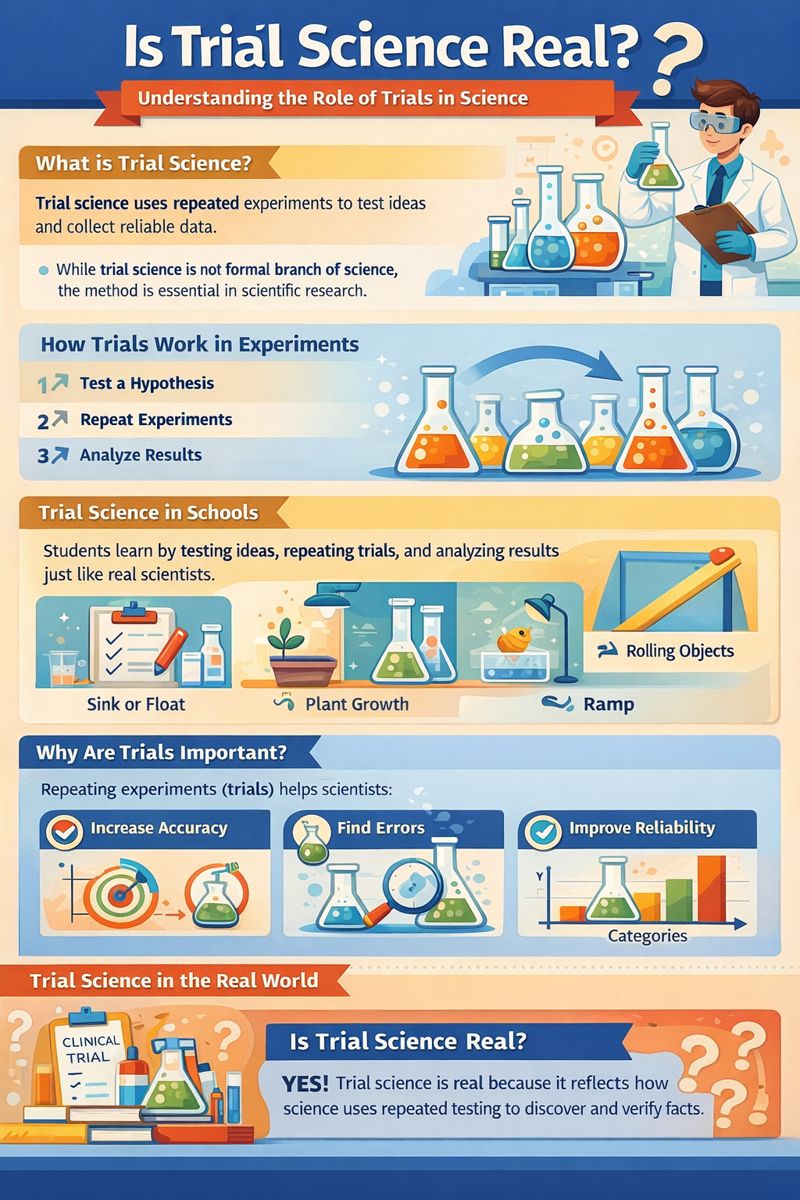
In scientific investigations, a trial is one repetition of an experiment. Scientists rarely rely on a single attempt because results can be influenced by chance, error, or uncontrolled variables. By performing multiple trials, scientists increase accuracy, consistency, and credibility. This trial-based approach is used across biology, chemistry, physics, and social sciences, making the underlying idea behind trial science very real and widely accepted.
The confusion often comes from terminology. People may wonder if “trial science” is a recognized field, similar to forensic science or environmental science. In reality, it is better understood as a methodological concept, not a standalone discipline. Trial science reflects the practice of testing ideas repeatedly, refining methods, and validating results through evidence rather than assumption.
From classrooms to professional laboratories, trial-based experimentation is a cornerstone of scientific thinking. So when people ask, is trial science real, the answer is yes—because science itself depends on trials to move from questions to conclusions.
How Trials Work in Real Scientific Experiments
To fully answer is trial science real, it helps to understand how trials function in real scientific experiments. A trial is a single execution of an experiment under controlled conditions. Scientists repeat trials to ensure that results are not accidental and can be reproduced. Reproducibility is one of the most important principles in science.
For example, if a scientist is testing how sunlight affects plant growth, one trial would involve growing plants under a specific amount of light and measuring their growth. To strengthen the experiment, the scientist repeats this process multiple times, often with different samples but the same conditions. These repeated trials help confirm whether the observed effect is consistent and reliable.
In chemistry, trials are used to test reactions, measure reaction rates, or compare concentrations. In physics, trials may involve repeated measurements of motion, force, or energy. Even in psychology and medical research, trials—such as clinical trials—are essential for testing treatments and therapies. This widespread use shows that trial-based science is not only real but essential.
Trials also help scientists identify errors. If one trial produces an unusual result, repeating the experiment helps determine whether that outcome was due to experimental error or a real phenomenon. This process of testing, analyzing, and repeating forms the backbone of scientific discovery and reinforces why trial science is a valid and necessary approach.
Trial Science in Education and Classroom Learning
In educational settings, the question is trial science real often arises when students encounter trial-and-error experiments in school. In classrooms, trial science is commonly introduced through hands-on activities where students test ideas, record results, and repeat experiments. These learning experiences mirror how real scientists work.
For younger students, trial-based experiments might include testing which materials float or sink, which objects roll the farthest, or how different conditions affect melting ice. Each attempt is a trial, and students learn that results can vary. By comparing outcomes across trials, they begin to understand patterns, averages, and scientific reasoning.
In middle and high school, trial science becomes more structured. Students learn to control variables, design fair tests, and perform multiple trials to ensure accuracy. Lab reports often require students to record data from several trials and calculate averages, reinforcing the idea that science depends on repetition and evidence.
Trial science in education also builds critical thinking skills. Students learn that failure is part of the process and that unexpected results are opportunities for learning. This mindset reflects real-world science, where breakthroughs often come after many trials. As a result, trial science is not only real but also a powerful teaching tool that prepares students for advanced scientific study.
Is Trial Science Real in Professional Research and Innovation?
Beyond the classroom, is trial science real becomes even more evident in professional research and innovation. Scientific progress depends heavily on repeated experimentation, testing, and refinement. From developing new medicines to improving technology, trials play a central role in turning ideas into reality.
One of the most well-known examples is clinical trials in medical science. Before a new drug or treatment is approved, it undergoes multiple phases of trials involving thousands of participants. These trials test safety, effectiveness, dosage, and side effects. Without trial-based science, modern medicine would not exist.
In engineering and technology, trial science appears through prototyping and testing. Engineers design, test, revise, and retest products before they reach the market. Each version represents a trial that contributes to better performance and reliability. Environmental science also relies on repeated trials to study ecosystems, climate patterns, and conservation strategies.
Even space exploration depends on trial science. Experiments conducted on Earth, repeated simulations, and multiple test launches all serve as trials to reduce risk and improve success. These real-world applications make it clear that trial science is not just real—it is essential to innovation, safety, and scientific advancement.
Frequently Asked Questions
Is trial science a real branch of science?
Trial science is not a formal branch, but it is a real and essential scientific method involving repeated experiments to test hypotheses and verify results.
Why are multiple trials important in science?
Multiple trials increase accuracy, reduce error, and ensure results are reliable and reproducible.
Is trial science the same as trial and error?
Trial science includes trial and error, but it is more structured. It involves controlled testing, data collection, and analysis rather than random guessing.
Do all scientific experiments require trials?
Most experiments require multiple trials, especially when accuracy and reliability are important. Some observations may not, but repetition strengthens scientific conclusions.
How does trial science help students learn?
Trial science teaches students critical thinking, data analysis, and resilience by showing that learning comes from testing ideas and improving through repetition.